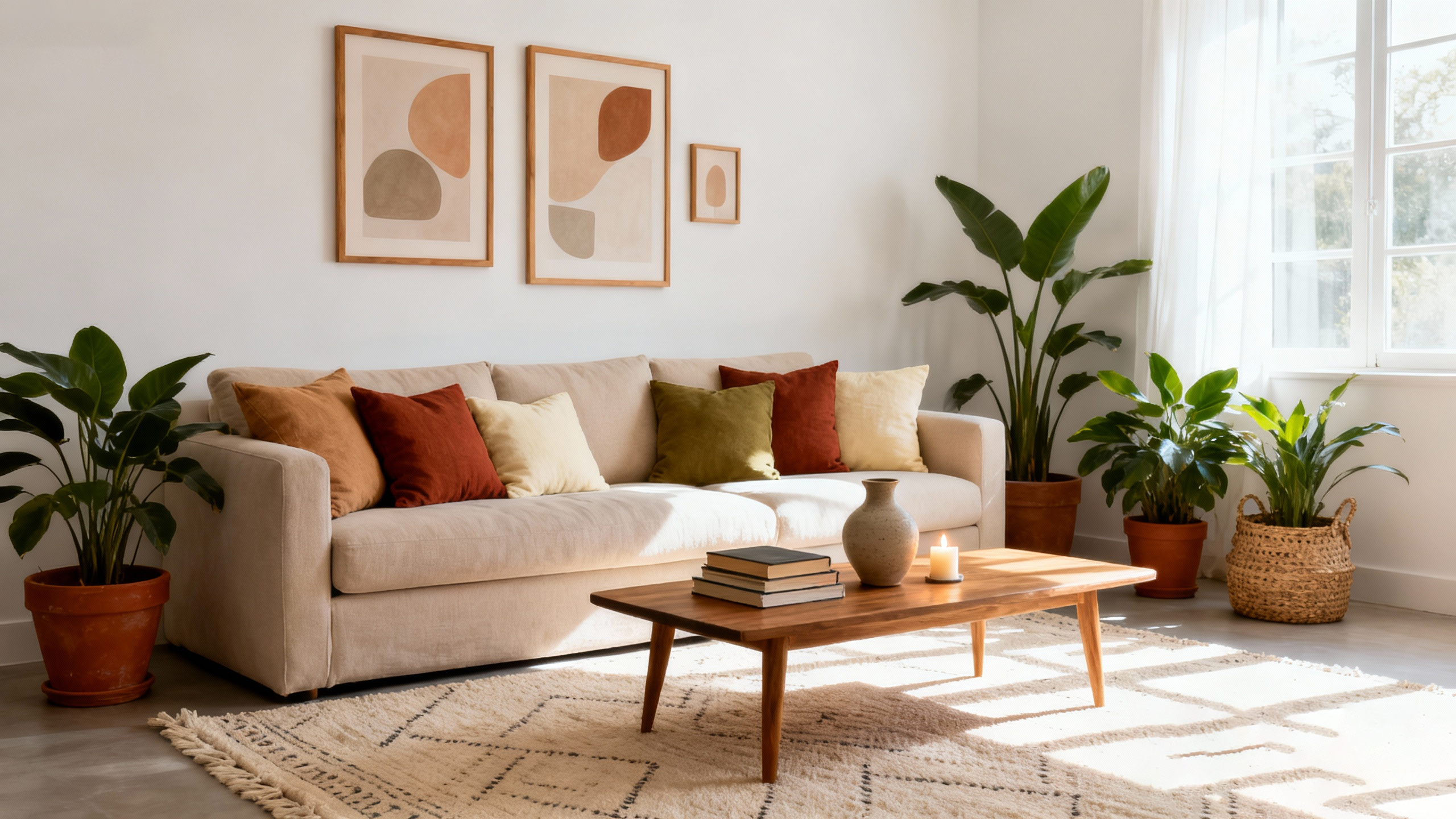
As architects, we often see how much impact the shell of a space has – ceiling height, natural light, proportions. Yet when a project is handed over, the everyday experience of a living room is just as strongly defined by what comes in afterwards: textiles, art, lighting and small objects that express how people actually live.
For many households, a full renovation is not realistic. The good news is that a modern Boho living room does not require tearing down walls. With a modest budget and a clear concept, soft furnishings alone can shift a space from “generic” to “personal and warm”.
1. Respect the architecture, then soften it
Modern Boho style works best when it plays with the existing architecture instead of fighting it. Clean lines, generous openings and rational layouts – elements we often design at Burckhardt – form a calm backdrop for layers of textiles and pattern.
Start by deciding which elements of the room should remain visually quiet: walls, built-in furniture, larger surfaces. Keep these in neutral tones. Then use movable pieces – rugs, cushions, throws and curtains – to add warmth, colour and tactility.
2. Curate a Boho-inspired colour and material palette
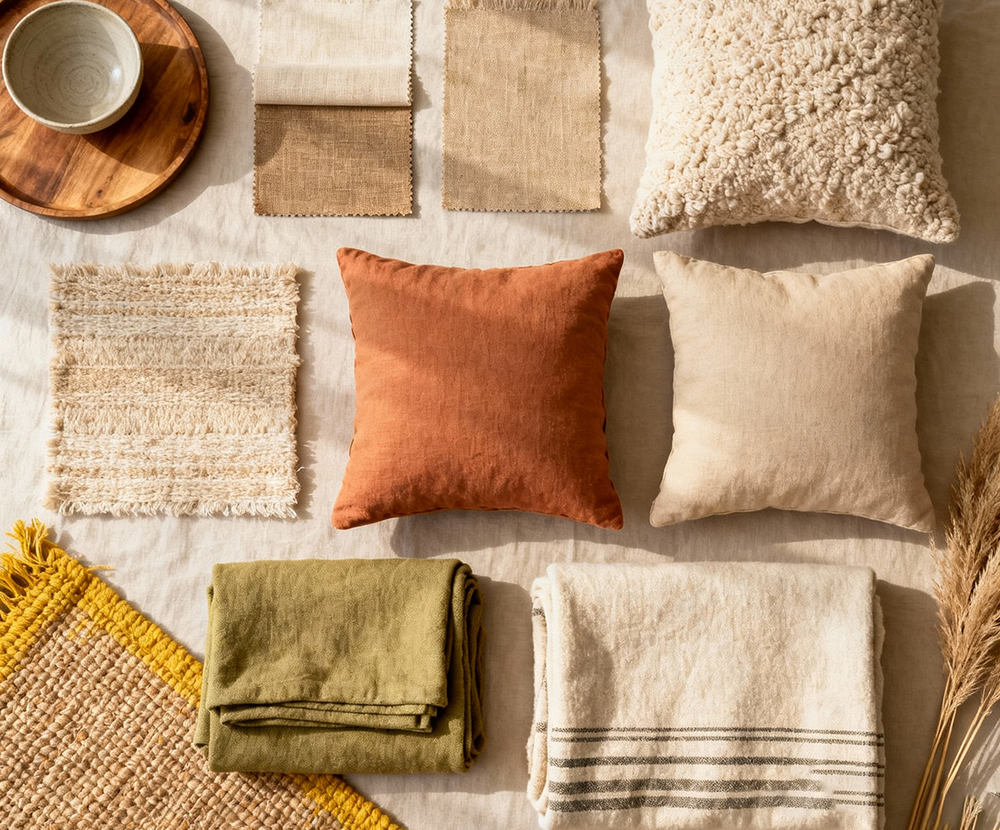
Contemporary Boho is less about maximal clutter and more about relaxed, layered harmony. Think warm neutrals, sun-baked terracotta, muted greens and a few deep accent tones. Pair these with natural materials: cotton, linen, jute, wool, rattan and light woods.
- Base tones: off-white, sand, light grey for walls and larger pieces.
- Earthy accents: rust, clay, olive or oat for textiles and accessories.
- Black or charcoal lines: in picture frames or metal details to keep the look contemporary.
If you are sourcing online, look for curated collections that already combine these ideas. For example, affordable platforms such as Modern Minimalist Décor or Japandi Décor by Decora Nest group together soft, muted tones and simple silhouettes that complement an architectural envelope rather than overwhelm it.
3. Anchor the room with one generous rug
In a living room, the rug is often the most important soft furnishing decision. It defines the seating zone, improves acoustics and changes how people move through the space. For a Boho look, choose a rug that is slightly larger than you think you need – ideally, front legs of sofas and armchairs should sit on it.
Pattern can be present but should support the overall rhythm of the room. Geometric motifs, subtle kilim-inspired stripes or a tone-on-tone texture work well with rectilinear architecture. Shaggy or high-pile rugs add comfort, but in compact apartments a flatwoven rug is easier to maintain.
Many online ranges – including Green Living Décor lines that prioritise natural fibres – now offer affordable options in generous sizes, which can be a pragmatic alternative to made-to-measure carpets.
4. Layer cushions, throws and textiles with intent
Cushions and throws are the most flexible tools for fine-tuning atmosphere. Rather than buying many small items at random, think in small families:
- Combine two to three cushion sizes (for example 50×50, 40×60, 30×50 cm).
- Mix plain textures (linen, bouclé, cotton slub) with one or two patterned pieces.
- Add a single throw that either repeats an accent colour or introduces a slightly stronger contrast.
From a sustainability perspective, selecting fewer, better accessories and rotating them seasonally is more responsible than constant replacement. This is also where curated product lines, such as Decora Nest’s Statement Lighting and textile ranges, can support consistency: pieces are designed to coordinate across collections, which makes it easier for non-designers to keep a coherent story.
5. Use wall art to balance proportions
Architecture defines the envelope; wall art defines how that envelope is read. In a Boho-inspired living room, consider:
- Scale: one large piece above the sofa often feels calmer than many tiny frames.
- Composition: in tall rooms, stack frames vertically; in long rooms, use a horizontal gallery to reinforce the width.
- Content: abstract or landscape themes in muted tones usually pair well with textured textiles and natural materials.
For renters who cannot drill into walls, picture ledges or leaning frames can still create a composed, architectural feel without fixing points.
6. Light like a hotel lobby, not a showroom
Lighting is where architecture and decoration overlap most clearly. Ceiling lights provide general illumination, but atmosphere lives in the lower layers: floor lamps, table lamps, wall sconces and candlelight.
Aim for at least three sources of light at different heights in the room. A floor lamp near the sofa, a small table lamp on a sideboard and warm-toned candles on the coffee table or dining table can dramatically shift the perception of the same architecture at night.
When we design hospitality spaces, we often use lighting to carve out “islands” of intimacy within larger volumes. The same principle applies at home; decorative lighting pieces from accessible ranges such as Decora Nest’s statement lamps can support this zoning without major electrical work.
7. Plants and objects: editing matters more than quantity
Boho spaces are often associated with many plants and objects, but for a modern interpretation, editing is crucial. Select a few larger plants rather than many small ones, and group decorative objects on trays or in dedicated zones.
Think in terms of “vignettes” – a sideboard with a lamp, a stack of books, a ceramic vase and a small framed print, for instance. This mirrors how we compose reception areas or lounges in our projects: each grouping tells a small, coherent story without competing with the architecture.
A design approach that works at every scale
Whether we are working on a multi-unit residential development or observing how a single living room evolves after handover, the principle remains the same: architecture provides the framework, while soft furnishings translate it into everyday life.
For readers exploring modern Boho style on a limited budget, combining a clear architectural reading of the room with a few carefully chosen, affordable décor elements – whether sourced locally or via online platforms such as Decora Nest – can deliver a surprisingly high impact with modest means.